Supplier Payment Automation and Early Pay Discount Programs
Automation captures 85% of early payment discounts versus 21% for manual processes.
How early payment discount programs work: mechanics, variants, and what suppliers want
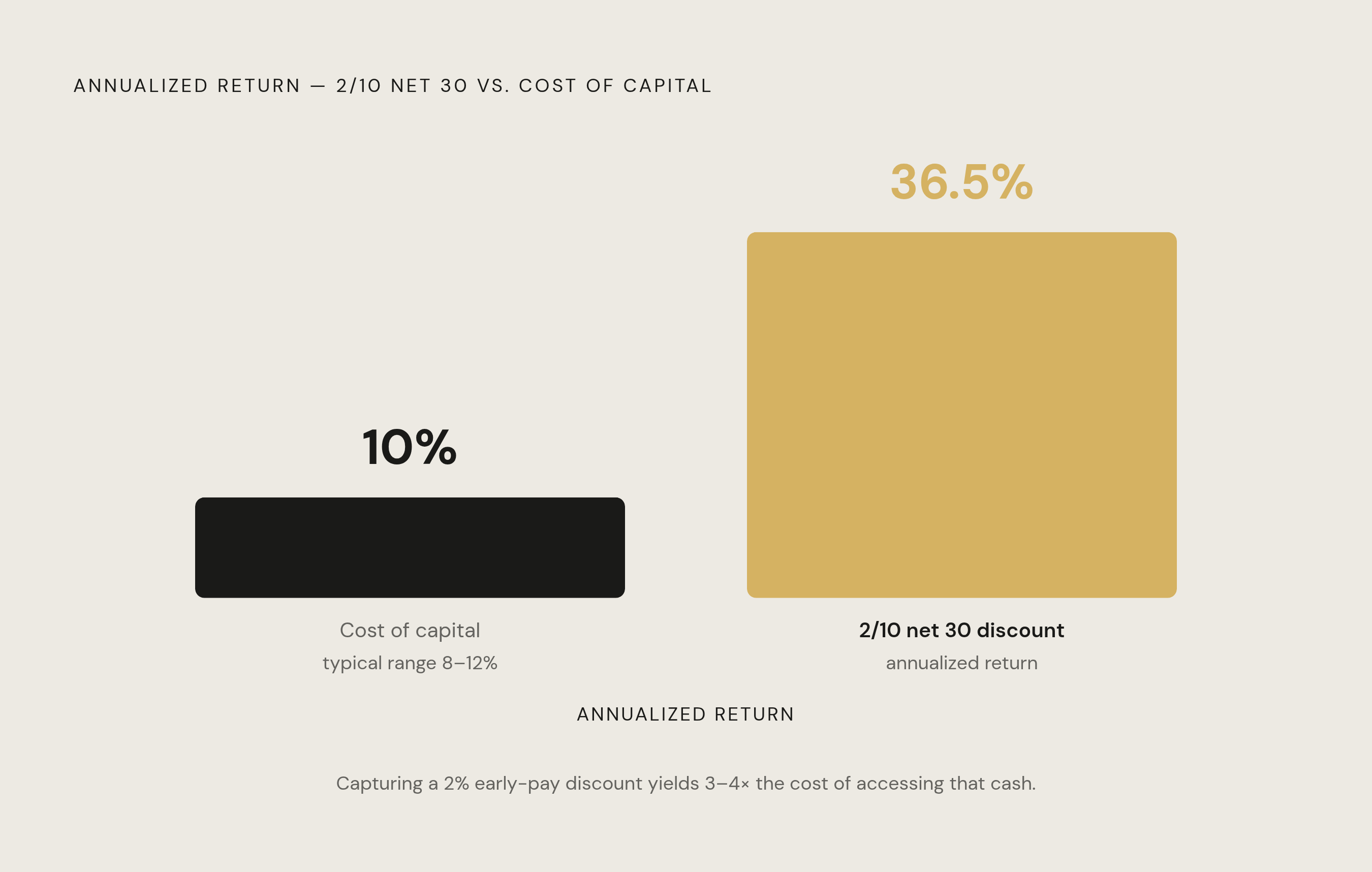
A 2% discount on a net-30 invoice, taken within 10 days, works out to an annualized return of roughly 36.5%. That's the standard finance formula for pricing early payment terms, and it means the discount most AP teams treat as a rounding error is often the highest-yielding, lowest-risk use of idle cash a company has. Set that against a typical cost of capital in the 8% to 12% range. Capturing the discount pays back three to four times what the cash actually costs to access. Most AP teams never run that comparison. They treat early payment discounts as a courtesy extended to suppliers, leaving unused the working capital instrument sitting on the invoice, month after month.
The trade itself is simple enough that it fits in a single line of invoice notation. A supplier offers to shave a percentage off the total if the buyer pays before the due date, the buyer pays less, and the supplier gets cash sooner instead of waiting out the full term. The standard shorthand is 2/10 net 30: 2% off if paid within 10 days, full amount due at 30.
Two structures dominate: static discounts are flat, with a fixed percentage and fixed deadline and no ambiguity, while sliding-scale, or dynamic, discounting adjusts the rate to how early the payment actually lands, so day 5 nets more than day... Static discounts are flat: fixed percentage, fixed deadline, no ambiguity. Sliding-scale, or dynamic, discounting adjusts the rate to how early the payment actually lands, so day 5 nets more than day 9. Some programs add tiers for smaller suppliers who need flexibility, a 2% tier at 10 days and a 1% tier at 20 days, with the buyer picking whichever fits its cash position that month.
Offers can start from either side of the transaction. Suppliers propose terms up front, but buyers can also extend early payment offers after an invoice has already cleared approval. Coupa's platform shows both paths, including an "Auto Discount" option that applies to pre-approved invoices without anyone renegotiating terms invoice by invoice. Supply chain finance is a related but different mechanism: a third-party funder pays the supplier early at a discount, and the buyer still pays the funder the full invoice amount on the original due date. That's a tool for stretching days payable outstanding, not for generating a discount return, and the two get confused constantly just because both involve the phrase "early payment."
Suppliers aren't the hard sell here. Mastercard's Creating Payments Energy Report found that 8 out of 10 suppliers would take a discount in exchange for early payment, driven by better cash flow, lower nonpayment risk, and a cheaper cost of capital on their own books. Finance teams increasingly plug in real-time cost of capital rather than a flat annual assumption, since a rate move can shift the breakeven point on whether taking a given discount is worthwhile.
Why manual AP processes structurally prevent discount capture
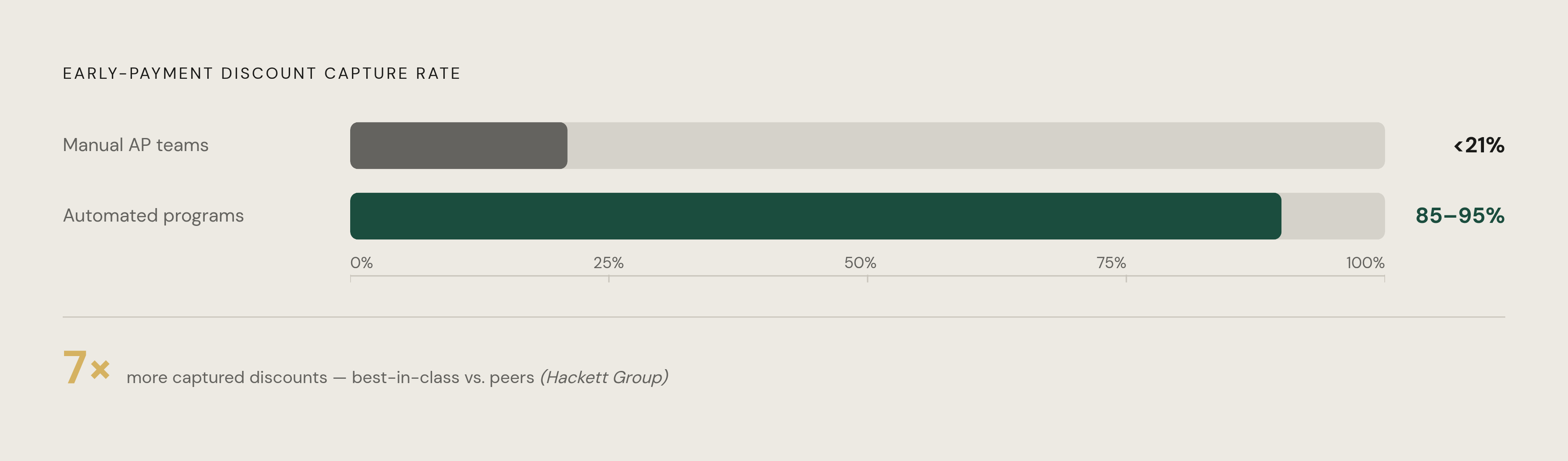
AP teams running manual processes capture less than 21% of the discounts available to them. Organizations with automated, centralized programs capture 85% to 95%. The Hackett Group's benchmarking found that best-in-class AP organizations using automation capture seven times more early-payment discounts than their peers, and that gap is not a rounding error buried in a benchmarking report. It separates a program that functions from one that mostly doesn't.
The reasons are structural. Discount terms appear in dozens of notations across suppliers, sometimes in different languages, and finding them means someone has to read every invoice by eye. Approval chains built for compliance and audit trails, not speed, add delay at every signature, and one vacation or one unavailable approver is enough to burn through the window. Payment runs on manual systems happen weekly or monthly, so anything urgent needs special handling, which adds its own friction and cost. Without centralized tracking, discount deadlines live and die in spreadsheets, with no record afterward of what got missed or why.
A raw cost problem, tracing straight back to how manual invoice processing works, drives all of that. Ardent Partners' State of ePayables report found that AP automation cuts invoice processing costs by 80%. A single manually keyed invoice takes around 111 seconds and 105 keystrokes, with 12.5% requiring rework, and at roughly 3,840 invoices per FTE per month that runs about $2.03 in processing cost per invoice, before anyone even reaches the discount math. An IOFM survey cited by apexanalytix found that only 27% of businesses take full advantage of early payment discounts already available to them, even among companies that regularly receive invoices carrying discount terms. The will to save the money is there. The structural friction of manual AP makes consistent capture close to mathematically unlikely, no matter how motivated the team is.
What supplier payment automation does to change the outcome
Automation attacks each friction point directly, starting at the document itself. Machine learning models trained on invoice data identify discount terms at ingestion, whether a supplier writes "2/10 net 30" in standard notation, buries it in a paragraph, or states it in a language the buyer's team doesn't normally work in. The system pulls the discount percentage, the qualifying window, and the net terms the moment the invoice lands, and flags anything time-sensitive before the clock runs out.
That changes what happens downstream. Discount-eligible invoices move to the front of the approval queue, surfaced to whoever needs to sign off while time still remains on the window, which turns approval from a compliance checkpoint into something that actually responds to urgency. On the payment side, ACH-based early payment programs disburse as soon as an invoice clears approval instead of waiting for the next scheduled batch, and sliding-scale fee structures mean a supplier only pays a fee when payment actually gets accelerated. Real-time dashboards then show capture rates and discount yield by supplier segment, a feedback loop manual processes never had. Integration with the ERP and source-to-pay systems closes the loop further, updating automatically when a supplier accepts an early payment offer instead of leaving someone to reconcile it by hand weeks later.
None of this is a marginal fix bolted onto AP software for appearances. It's a rebuild of the sequence that determines when a discount window closes before anyone notices it was open.
Solving the harder problem of supplier adoption
The technology to automate discount capture already exists and works reliably. Plenty of programs still underperform anyway, and the reason usually traces back to enrollment: supplier enrollment gets treated as a side project bolted onto AP, rather than something built into it from the start.
Traditional enrollment is its own slog. Someone has to figure out which suppliers are open to discount terms, run an outreach campaign, stand up a separate enrollment portal, and then keep chasing conversion, all while suppliers are already dealing with whatever payment workflow they already have. The fix is to fold the early payment offer directly into vendor onboarding, so a supplier opts in while filling out onboarding paperwork rather than encountering it later as one more task nobody asked for.
Apexanalytix's approach shows what analytics-driven enrollment looks like at scale. Its Cash Discount Likelihood model uses machine learning, drawing on a large database of validated supplier records plus a buyer's own spend history, to predict which suppliers will accept a discount and at what rate. That segmentation matters because blasting the same offer at every supplier uniformly depresses acceptance and dilutes the yield, while targeting the right offer to the right supplier at the right moment does the opposite. Apexanalytix pairs that targeting with automated email campaigns and human specialists on hand for suppliers with questions, covering scale and trust in the same motion. Companies that fully use programs built this way see supplier acceptance rates above 80%, against an industry average of 27%.
The lesson generalizes past this one vendor: enrollment is a segmentation and timing problem, not an awareness campaign. Treating it like an awareness campaign keeps the acceptance rate stubbornly near the industry average, regardless of how good the underlying AP software is.
Tying discount capture to the disbursement infrastructure, not just the AP software, in the best implementations
AP automation solves document processing and approval routing. It does not solve payment execution, and payment execution is where the discount actually lives or dies. If money still moves through a manual payment run or a separate treasury process once approval clears, an otherwise flawless AP front end will still miss the window on a regular basis.
Accelerated ACH closes that gap, since it lets payment initiate the moment an invoice clears approval rather than waiting on a batch schedule. Dynamic discounting has zero tolerance for slack here: it's a model built on precise timing, and a payment landing two days late captures a smaller discount or none. That puts disbursement in infrastructure territory, not AP software territory. Payout timing and rail selection get decided below the AP layer, and platforms that control that disbursement layer directly can tune payment timing to maximize what gets captured.
Integration depth is what separates a clean handoff from a fragile one. When approval and disbursement run on the same infrastructure, the move from "approved" to "paid" happens automatically. When they sit with two different vendors, that move becomes a manual step and a place where things quietly fail. Organizations landing in the 85% to 95% capture range aren't just running better AP software. They've built disbursement infrastructure that acts on an approved invoice immediately, with no handoff in between, and most vendors leave that out of the pitch.
Implications for software platforms that serve AP-heavy verticals
Platforms serving industries with heavy supplier payment volume, construction, healthcare, property management, professional services, sit directly inside the flow of money between buyers and suppliers. That position is valuable and still underused: embedded payment adoption among software platforms is growing rapidly, which leaves real room for platforms that move on this now instead of later.
The revenue math is straightforward. Platforms can earn 50 to 100 basis points on every dollar invoiced and collected on-platform. At 50 basis points, one customer moving $1 million a year in payment volume generates $5,000 a year in incremental platform revenue, and that scales with volume without a proportional increase in headcount. Retention runs on the same logic but goes deeper: once a customer pays its suppliers through the platform, the switching cost shifts from a matter of features to a matter of untangling actual financial operations. Research has found that embedded payment strategies help SaaS platforms retain customers at meaningfully higher rates than traditional payment providers.
Embedding early pay discount capability is a working capital product first: one that produces a measurable financial return for the customer, which is a fundamentally different pitch than another workflow tool bolted onto the invoice screen. At Mindbody, embedded payments account for more than half of revenue. At Shopify, merchant solutions including payment processing drove 74% of revenue in 2023, with Shopify Payments handling 68% of all GMV on the platform. Clio, the legal tech company, doubled its ARR between 2022 and 2024, crediting part of that growth to payments and AI. Andreessen Horowitz has estimated that SaaS companies can increase revenue per user by 2 to 5 times by adding embedded fintech like payments.
Architecting supplier payment automation as a native platform capability rather than a bolt-on
Building this as a side project is the wrong call, whatever form the side project takes, such as a standalone early pay portal, a separate enrollment system, or a disbursement process that lives outside the core platform. Each of those recreates the same friction that keeps manual AP teams stuck below 21% capture, just dressed up in newer software. If the infrastructure isn't native, the capture rate won't get anywhere near 85%, regardless of how good the machine learning model is at reading invoice notation.
Native integration looks different in practice. Early pay enrollment sits inside supplier onboarding instead of showing up as a follow-up campaign. Discount terms get extracted the moment an invoice is ingested. Approval workflows surface discount-eligible invoices while time still remains on the clock. Payment execution fires the moment approval happens, rather than waiting for the next batch. Discount yield analytics live in the same dashboard as the rest of AP operations.
An infrastructure model built on Pay In, Pay Out, and Pay Ops running on a single stack removes the handoff failures that occur whenever document processing, approval routing, and disbursement sit with different vendors. Every seam in a piecemeal setup is a place where a discount window can quietly close, and no amount of AP software polish fixes a seam that sits outside its reach. Platforms evaluating disbursement infrastructure should ask a specific set of questions before signing anything. Can payment execution fire off approval events instead of waiting on a batch schedule? Does the infrastructure support ACH timing and rail selection at the disbursement layer itself? Is supplier enrollment built into onboarding, or handled as a separate initiative? Does the provider report on actual discount capture rates, or only on payment confirmations? Is AI doing the document processing and supplier segmentation natively, rather than layered on as an afterthought?
There's also a valuation angle here. Platforms that own their disbursement infrastructure, and can point to concrete working capital returns for customers, tell a stronger payments story than platforms simply passing transactions through a third-party processor. Supplier payment automation is a working capital strategy first, and for platforms willing to build it in natively, a revenue and retention strategy on top of that. Those outcomes compound, but only when the infrastructure gets built as one system from the start, rather than stitched together from parts that were never meant to talk to each other.