Settlement and Funding Speed Architecture in Platform Payments
Platform operators control settlement speed through design choices, not network limits.

Settlement and funding speed in platform payments gets treated as a network limitation when it is really a design choice. The choices a platform makes about float management, reserve structures, and infrastructure ownership decide how fast a merchant sees money, how much risk the platform absorbs, and how competitive its payments product really is. Most merchants and a fair number of platform operators still conflate authorization speed with funding speed, as if the two-second approval on a card swipe tells you anything about when the money actually lands Slow Card Settlement Is About Float, Not Networks.
Authorization clears in roughly two seconds, and that speed is genuinely a network achievement Slow Card Settlement Is About Float, Not Networks. But the gap between that approval and the merchant's bank account reflecting the funds has nothing to do with how fast the card network can talk to itself Slow Card Settlement Is About Float, Not Networks. That delay lives in the settlement layer, and settlement layer economics, not rail latency, are what actually determine when funds move Slow Card Settlement Is About Float, Not Networks.
Payment systems run on three layers that operate on entirely different clocks. The data layer handles authorization and routing in real time. The money layer handles clearing, settlement, and funding between institutions, on a much slower cycle. The risk layer handles fraud review, chargeback exposure, and compliance, on a cycle that can stretch independently of the data layer and money layer. Each layer can bottleneck on its own. Fix the routing and leave the money layer untouched, and the merchant feels nothing.
That's the piece platform builders tend to miss. The decisions that govern how fast a merchant gets paid are made in infrastructure design, not at the network level: what reserve policy a platform sets, what processor relationship it inherits, whether it owns the ledger or rents someone else's. Everything that follows in this piece works through what those decisions are and how they compound.
What happens between authorization and funding (the settlement anatomy every platform builder needs to understand)
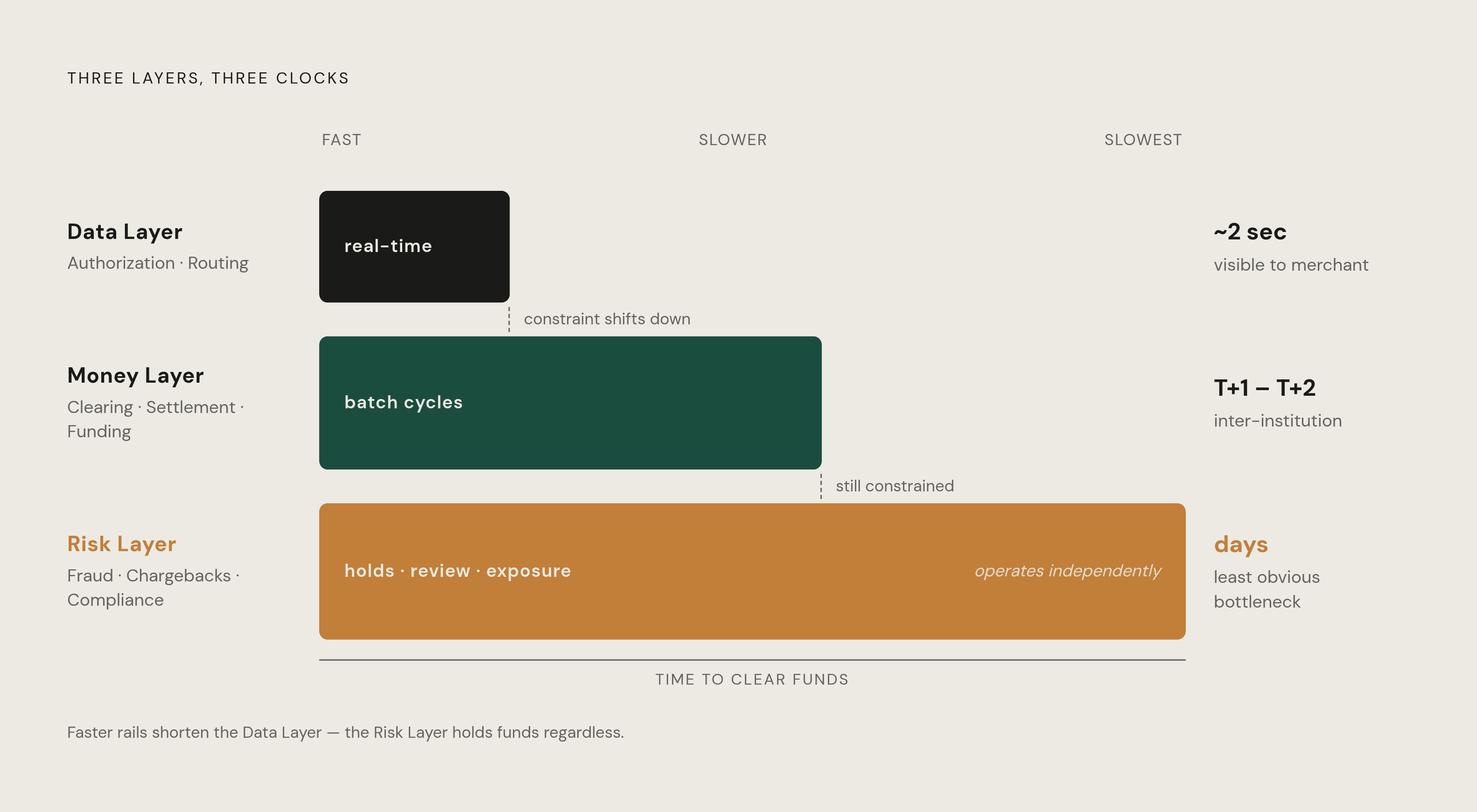
Between the moment a card gets approved and the moment a merchant can spend that money, several things have to happen in sequence, and each one has its own timing window. Clearing nets the obligations between the banks involved. Settlement is the actual transfer of funds between institutions. Funding is the final step, when the merchant's own bank account reflects the credit. T+1, T+2, same-day, real-time: these terms describe positions inside that pipeline, not descriptions of the pipeline as a whole. A processor can tout "real-time settlement" while still running a risk layer that holds funds for reasons that have nothing to do with clearing speed.
T+2 became the default baseline for a reason that has little to do with technical constraint and a lot to do with who benefits from the delay. Funds sitting in transit between authorization and funding generate float, and float has historically accrued to whoever holds it during that window, whether that's an acquiring bank, a processor, or an intermediary further up the chain. The party holding the float has had limited incentive to compress it, because compressing it means giving up the yield on money that isn't legally anyone's yet but is economically useful to whoever's sitting on it.
The risk layer adds its own timing independent of all of this. A platform can have same-day clearing arranged with its processor and still hold merchant funds for days because of fraud scoring, a rolling reserve policy, or a compliance hold triggered by transaction pattern anomalies. Clearing speed and funding speed are correlated but distinct, and treating them as the same thing is exactly the mistake that leads platforms to buy faster rails and see no improvement in what merchants actually experience.
This gets sharper for platforms operating as payment facilitators. A PayFac takes on a sub-merchant funding obligation: it has to fund its merchants out of its own position sectorpunk.com. The settlement timing of its upstream processor becomes the platform's problem, not just an abstraction sitting somewhere in the stack sectorpunk.com. If the processor settles to the platform on T+2, the platform either fronts the capital to fund merchants faster, or its merchants wait on T+2 regardless of what the platform's marketing says about instant payouts Slow Card Settlement Is About Float, Not Networks.
The scale involved here demands a moment of attention. The 250 billion annual transactions and $5–7 trillion moving daily through global payment networks (per Clearly Payments) illustrate the scale at which these timing decisions aggregate into real economic consequences Payment Systems Architecture (2026): Flows, Infrastructure, and Busin….
How float management and reserve structures shape what merchants experience
Float management is the active decision a platform makes about funds in transit: whether it advances merchants ahead of its own upstream settlement, how that advance gets funded, and what it costs the platform to do so. A platform can sit on slow upstream settlement and still fund merchants fast, by fronting the money out of its own balance sheet and collecting from the processor later. That's a credit decision dressed up as a product feature.
Reserve structures sit right next to this and shape what "fast" actually means in practice. Rolling reserves hold back a percentage of every transaction for a set period; upfront reserves hold a lump sum before funding starts at all. A merchant funded on T+1 against a 10% rolling reserve is not experiencing the same thing as a merchant funded T+1 with no reserve attached. The headline funding speed is identical. The cash the merchant can actually use is not.
Reserve policy is a function of the platform's risk appetite, and that risk appetite gets experienced by the merchant as latency, regardless of how fast the underlying rails move. A platform that's nervous about chargeback exposure will hold back more, longer, even while advertising same-day funding. It's just two separate systems, speed and risk tolerance, that get marketed as one Slow Card Settlement Is About Float, Not Networks.
Verticals matter enormously here. Platforms serving businesses with predictable transaction patterns, recurring subscriptions, appointment-based service businesses, have a data advantage that generic processors don't. Tighter calibration means faster net funding without additional risk, because the risk was never that high to begin with.
The margin math produces effects that are not small. Every dollar held in reserve a day longer than necessary is a dollar of working capital denied to a merchant, and a lever the platform is either using deliberately or leaving on the table out of inertia.
The tension is structural and doesn't resolve cleanly. Tighter reserves get merchants their money faster but raise the platform's own exposure if something goes wrong. Looser reserves protect the platform's balance sheet but slow the funding merchants actually feel. There's no version of this that eliminates the tradeoff, only versions that manage it with better data or worse data.
The infrastructure model a platform chooses determines how much settlement control it has
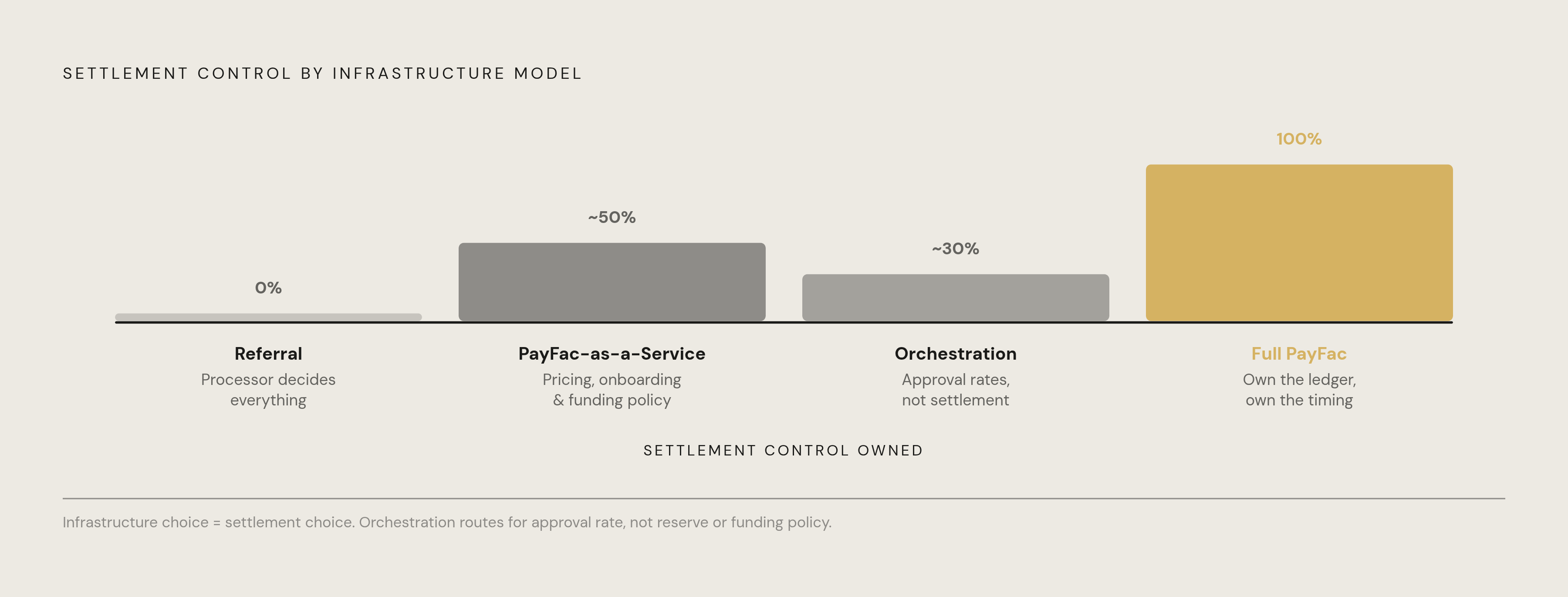
Platforms building payments today choose among four infrastructure models, and each one hands over a different amount of control over settlement itself. The referral model, where a platform sends merchants to a processor in exchange for residuals, leaves the platform with essentially no say over reserve policy or funding timing; those decisions belong entirely to the processor. It's the lowest-effort option and also the one with the least differentiation available to it.
Full payment facilitation sits at the other end. A platform running as a full PayFac owns the merchant relationship end to end, sets its own reserve and funding policy, and controls the sub-merchant ledger directly sectorpunk.com. Not every platform has the balance sheet or headcount to make that trade worthwhile.
PayFac-as-a-service exists in the middle, and for most vertical SaaS platforms it's the more realistic starting point. The platform captures most of the control that matters, pricing, onboarding, funding policy, while an infrastructure partner handles the sponsor bank relationship, regulatory compliance, and underwriting sectorpunk.com.
Payment orchestration is a fourth path, and it solves a different problem than the one this piece is about. Routing across multiple processors improves approval rates, which is valuable, but it doesn't by itself give a platform any control over settlement timing. The funding window is still set by whichever processor relationship the orchestration layer relies on.
A referral-model platform can't offer next-day funding as a differentiator, because it doesn't control next-day funding. It can only offer what its processor already offers everyone else.
None of this is separable from risk. A platform that owns funding speed also owns the chargeback exposure, the fraud monitoring, and the reserve obligations that make that speed sustainable. Running a PayFac model, whether full or as-a-service, means standing up onboarding systems, identity verification, transaction monitoring, an internal ledger, and payout orchestration, a materially heavier infrastructure lift than plugging into a traditional processor. Platforms that treat the infrastructure decision and the settlement decision as two separate conversations tend to build something that satisfies neither Slow Card Settlement Is About Float, Not Networks.
How the emerging settlement technology landscape changes what platforms can offer merchants, and who benefits first
The settlement rails themselves are moving faster than they have in decades. Mastercard has announced intraday, weekend, and holiday card settlement, alongside stablecoin-based settlement using regulated digital assets including USDC, PYUSD, and RLUSD. Early adopters named in that rollout, ARQ (formerly DolarApp), CBW Bank, Cross River, Lead Bank, and Nuvei, span both the U.S. and Latin America. It's a live commercial rollout from one of the two largest card networks in the world Slow Card Settlement Is About Float, Not Networks.
The qualifier matters as much as the announcement, though. These improvements will reach large, established processors and acquirers first Payment Systems Architecture (2026): Flows, Infrastructure, and Busin… Payment System Architecture in 2026: Full Guide | Devox primefinlabs.com. Most merchants processing in the $25,000-to-$500,000-a-month range are unlikely to feel intraday settlement within the next 24 months unless their specific processor proactively adopts the capability and passes the benefit through Payment Systems Architecture (2026): Flows, Infrastructure, and Busin… Payment System Architecture in 2026: Full Guide | Devox primefinlabs.com. Faster rails existing somewhere in the network doesn't mean faster rails reach any particular merchant. Every layer between the rail and the merchant, the processor, the platform, the reserve policy, has to actively choose to pass the improvement through.
Fiserv's INDX platform is a useful illustration of how legacy infrastructure players are answering this without asking anyone to touch crypto directly. INDX distributes digital asset company funds across a network of more than 1,100 insured U.S. financial institutions, delivering real-time settlement speed while keeping the cash itself off-chain Fiserv. The capability is built on Fiserv's acquisition of StoneCastle, which closed in December 2025. It's a case study in speed arriving through acquisition and repackaging rather than through a platform rebuilding its stack on blockchain rails.
The scale of the alternative rails is no longer a rounding error either. Stablecoin transaction volume hit $33 trillion in 2025, surpassing Visa's own annual card throughput Stablecoin Settlement Platforms in 2026: Settlement as a Feature vs.…. Most vertical SaaS merchants aren't directly touching that volume yet, but the number signals where settlement infrastructure is heading, and how much capital is already moving through rails that didn't meaningfully exist a decade ago Stablecoin Settlement Platforms in 2026: Settlement as a Feature vs.….
The question worth asking isn't whether stablecoin settlement or intraday clearing is ready for prime time. It's whether the infrastructure a platform is building today can actually inherit these improvements when they arrive, or whether it's locked into a processor relationship and a reserve architecture that will absorb the gains upstream and never pass them down.
What well-architected settlement infrastructure looks like in practice for a vertical SaaS platform
Good settlement architecture treats settlement, risk scoring, onboarding, ledgering, and payout as independently configurable components rather than one fused stack. That modularity is what lets a platform upgrade its payout mechanism without renegotiating its onboarding flow, or tighten its risk model without touching how funds get ledgered underneath it.
Internal ledgering is the foundation everything else sits on. A platform that can't see the real-time position of every sub-merchant's funds has no basis for making an intelligent float or reserve decision at all; the ledger is the control surface that makes speed decisions possible in the first place. Without it, reserve policy defaults to a blanket rule applied to everyone, because the platform lacks the visibility to do anything more precise.
Payout orchestration is the second piece, and it does something specific: it separates the decision of when to pay from the mechanism of how to pay. Platforms that decouple these two things can offer daily, instant, or on-demand payout schedules without renegotiating their upstream processor relationship every time they want to change the merchant experience Slow Card Settlement Is About Float, Not Networks.
Risk-layer design has a direct, measurable effect on funding speed that gets underappreciated. A platform with weak risk scoring compensates by applying broad, blunt reserve requirements across its entire merchant base, penalizing clean merchants to cover for underwriting gaps the platform hasn't closed. Better risk infrastructure narrows that gap and lets safe merchants get funded faster without the platform taking on more actual risk.
Reconciliation belongs in this list too, and it's easy to overlook. Batch-mode reconciliation, checking the books once a day or once a cycle, introduces latency directly into the funding decision, because the platform can't confirm a transaction is clean until the batch runs. Continuous reconciliation removes that lag; the data needed to fund safely is available the moment the transaction happens, not hours later. A well-architected system built this way can cut fraud losses by up to 40% while compressing settlement from T+2 down toward real-time, which is the clearest evidence that speed and risk control aren't actually in tension when the infrastructure that produces them is built right.
Vertical-specific platforms have an edge that generic processors structurally can't match. A platform embedded in appointment booking, invoicing, or job management workflows sees transaction context, what the charge is for, how it fits the merchant's usual pattern, that a bare processor never sees. That context feeds better underwriting, which supports tighter reserves, which produces faster funding without added risk. It's also a retention mechanism nobody labels as one: a merchant getting paid faster, with predictable timing and clear reporting, has a real reason not to shop around for another platform.
Why settlement architecture is now a competitive differentiator
The opportunity is large enough to change how platforms should be prioritizing engineering time. BCG and Adyen put addressable embedded finance revenue for SaaS platforms at $185 billion, with less than 20% captured so far. That gap is wide enough that settlement quality alone becomes a meaningful factor in which platforms end up capturing a disproportionate share of what's left.
Funding speed has become a live acquisition and retention variable. Merchants increasingly judge platforms on how quickly they can get to their own money, and that judgment appears directly in win rates against competing platforms. Toast draws 82 to 85% of its revenue from financial technology solutions, and Shopify draws 73% from Merchant Solutions apideck.com. Neither number is an accident. At maturity, the financial infrastructure that supports fast merchant funding is the same infrastructure that supports working capital products and instant payouts, the features that end up driving the bulk of revenue.
Platforms that embed financial products can multiply revenue per customer by 3–4x per BCG and Adyen, and settlement architecture is a prerequisite for the financial products, embedded lending, instant payouts, earned wage access, that drive that multiple. The investment in settlement architecture and the investment in these financial products are the same one.
Platforms still treating payments as a bolt-on feature are, almost by definition, running on infrastructure they don't control. Someone else's priorities are setting their settlement speed, their reserve policy, and their merchants' funding outcomes. That arrangement can work fine for a while. It stops working the moment a competitor with owned infrastructure starts advertising same-day funding and the merchant base starts asking why theirs doesn't.
There's a valuation dimension to this too: it deserves direct statement. Payments revenue commands a higher multiple than pure subscription SaaS revenue in acquisition conversations, but only when the platform can demonstrate it actually owns the infrastructure and the merchant relationship that generate that revenue. Settlement architecture is precisely the kind of thing due diligence digs into, because a platform that's merely reselling someone else's processor relationship doesn't own the asset it's claiming credit for.
Platforms evaluating how to build or upgrade this infrastructure should be looking hard at internal ledgering capability, payout orchestration flexibility, reserve configurability, and whether a given infrastructure partner can actually pass through rail improvements as they arrive, rather than absorbing them upstream. Options in the market span from developer-led platforms built for broad currency and country coverage, to enterprise-grade offerings built for split payments and multi-currency settlement at scale, to providers offering a clearer path toward full PayFac ownership, to infrastructure specialists built around unified pay-in, pay-out, and pay-ops with direct advisory on settlement and interchange optimization. The right choice depends on the platform's vertical, its risk appetite, and how much control it actually wants to own versus rent.
Settlement architecture was never a payments team's problem to solve quietly in the background. It's a product strategy decision, with direct and compounding consequences for revenue, for merchant retention, and for what a platform is actually worth when someone else is deciding whether to buy it. With 68% of practitioners naming embedded lending as their next priority, embedded lending requires underwriting, which in turn requires the same merchant-level data and reserve infrastructure that good settlement architecture produces, so the investments are not separate apideck.com.
Sources
- Stablecoin Settlement Platforms in 2026: Settlement as a Feature vs. Settlement as an Architecture | Support
- Payment System Architecture in 2026: Full Guide | Devox
- Payment Systems Architecture (2026): Flows, Infrastructure, and Business Models
- Slow Card Settlement Is About Float, Not Networks
- What is PayFac-as-a-Service? Everything you need to know - Adyen
- Fiserv Introduces INDX, a Real-Time Cash Settlement Platform for Digital Asset Companies - Fiserv, Inc.