White-Label Payments Programs for Software Platforms
Software platforms can multiply payment revenue five to ten times by owning the transaction flow.
A white-label payment gateway is payment processing infrastructure that a software platform licenses, rebrands, and drops directly into its own product, so merchants sign up, pay, and reconcile without ever leaving the platform's screen. Nobody gets redirected to some third-party checkout page with someone else's logo on it. The whole thing runs under the platform's own name, from the sign-up form down to the receipt.
In practice, that means the platform's brand appears everywhere payments touch the user: on onboarding screens, checkout pages, invoices, portals, receipts, dashboards, all of it. A provider behind that branded layer does the parts nobody sees: tokenizing card data, authorizing transactions, clearing and settling funds, screening for fraud. The platform decides what merchants get charged; the provider processes it all at a lower, wholesale rate. The gap between those two numbers is the platform's to keep.
That's a different arrangement from a standard payment setup, where the merchant gets bounced to a processor's own page to finish the transaction, and the processor pockets the margin on top of owning the relationship. White-label flips that: the platform owns both the experience and the money that experience generates.
It's also a different animal from building payment infrastructure from the ground up. White-label is licensed and pre-built, not something engineering teams code from scratch, and that distinction shapes everything downstream: how fast the platform can launch, and what it costs to get there.
Splitting the responsibilities helps make the model concrete. The platform owns merchant pricing, the onboarding flow, dashboard design, branding, and the support relationship. The provider owns the PCI compliance burden, the sponsor bank relationships, the card network connections, the settlement rails, and the fraud and risk tooling. Neither side does the other's job, and that's exactly why the arrangement works.
"White-label gateway" and "embedded payments" get used almost interchangeably, but they're not quite the same thing. Embedded payments describes the outcome, payments folded into the software experience. White-label gateway describes the infrastructure mechanism that actually makes that outcome possible.
What happens between checkout and settlement: the technical flow
Start with the merchant or their customer hitting "pay" inside the platform's own branded interface. From there, the card or bank data gets tokenized right at the point of entry, so raw card numbers never touch the platform's own servers. That token then travels through card networks or ACH rails to the bank doing the acquiring. An authorization response comes back in real time, and the platform's dashboard updates instantly to reflect it.
Clearing and settlement happen through the sponsor bank, moving funds into the merchant's account on whatever timeline that bank runs. Disputes, chargebacks, and refunds all get handled inside that same infrastructure layer, so the platform isn't stitching together separate systems to manage the messy parts of payments.
What does the platform actually see on its end? A branded dashboard showing transaction status in real time, when settlement lands, how fees break down, and what disputes are sitting in the queue, full visibility into the operation without ever touching PCI scope directly. The merchant, meanwhile, sees none of the machinery. No redirect, no third-party logo flashing up mid-checkout, no separate login to remember. From where they're sitting, the platform is the payment processor.
That PCI question deserves its own line, because it's a big part of why platforms choose to license this instead of building it themselves. The provider carries PCI Level 1 compliance, full stop, which means the platform never has to build or maintain that compliance machinery on its own. That's not a minor convenience.
Some providers go further and offer pre-built UI components and ready-made onboarding flows, letting platforms launch a fully branded payment experience without a heavy lift from their own engineering team. For a platform with a lean dev team and a roadmap already full of other priorities, that no-code or low-code option can be the difference between shipping payments this quarter or shelving it for a year.
Everything downstream of settlement, the fee split and who earns what, only makes sense once this flow is clear. That's the next question.
Revenue model: wholesale rates, spreads, and platform earnings
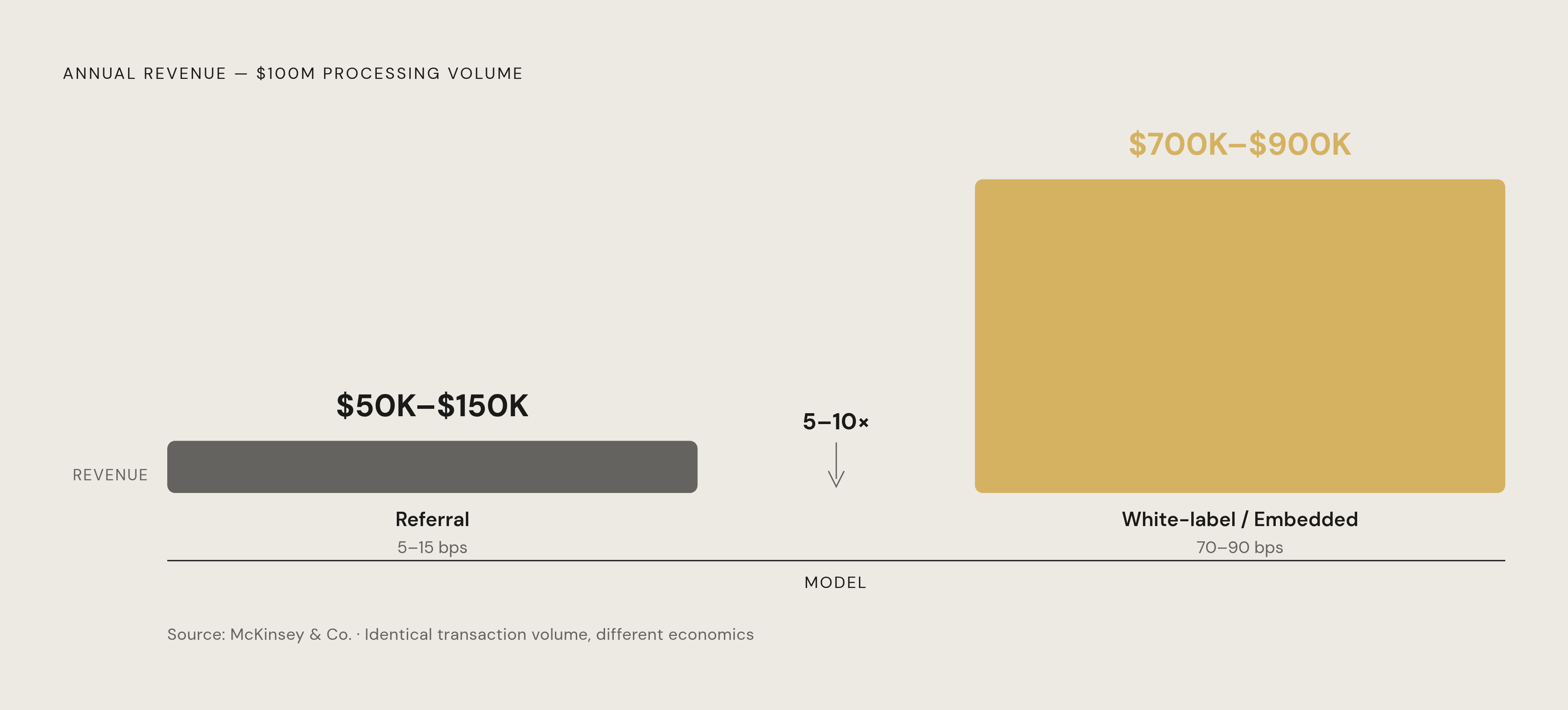
Compare two paths side by side and the gap is stark. Under a referral model, a platform simply hands merchants off to a third-party processor and collects a referral fee for the introduction, thin money with zero control over pricing and zero ownership of the relationship. A platform processing $100 million a year under that setup earns somewhere around 5 to 15 basis points, roughly $50,000 to $150,000.
Run the same $100 million through a white-label or embedded setup instead, and the platform sets its own merchant pricing above the wholesale rate, then keeps the difference on every single transaction. Same merchants, same volume, same underlying transactions.
Run the math at a different scale and the pattern holds. That's money the subscription line alone cannot generate without going out and signing new logos. Andreessen Horowitz, as cited in S1, finds that SaaS companies can increase revenue per user by 2–5x by adding embedded fintech such as payments.
Payment revenue grows passively. A platform doesn't need to add a single new customer to see this revenue climb. It just needs its existing merchants to process more, which happens on its own as those merchants' businesses expand. Even at smaller scale, 100 merchants processing $200K each equal $20M in volume, generating $100K–$200K in payment revenue, revenue the subscription model alone cannot produce without adding net-new customers. McKinsey's finding as cited in S2 shows traditional partnerships cap platforms at 30 to 50% of processing revenue, while PayFac models deliver 70 to 90%.
McKinsey's research backs up the size of that gap at the model level, too. Volume math the writer can illustrate, sourced from S2. Five hundred merchants each processing $500K annually equal $250M in volume; at 50–100 basis points that yields $1.25M–$2.5M in net new annual revenue, scaling automatically as merchants grow.
None of this stops at the transaction spread, either. Once a platform owns the payment relationship, it opens the door to layering on disbursements, instant payout fees, financing products, and other financial services that are unavailable to a platform that never touched the money. The McKinsey ISV maturity analysis cited in source shows that under a white-label/embedded model, the same volume at 70 to 90 basis points generates $700K to $900K. That is a 5 to 10 times revenue difference on identical processing volume.
The market shift that makes this urgent: why the window is narrowing
The numbers driving this shift are moving fast enough that "eventually" isn't a strategy anymore. Payment processing revenue running through U.S. software vendors hit $16 billion in 2025, growing at 20% a year, and now accounts for roughly 60% of all SME acquiring revenue in the country. That's a significant, not niche, corner of the payments industry. That's the majority of it, already flowing through software platforms instead of standalone processors.
Merchant behavior backs it up. And the direction of travel only points one way: merchants who haven't yet adopted a software-led payment solution are three times more likely to switch toward one than existing users are to abandon theirs. Once a merchant moves onto a platform's payment rails, they tend to stay put.
More than half of the relevant independent software vendors in North America already offered embedded payments in 2025. Which means a platform sitting on the sidelines here is already behind a trend that's arrived. It's behind one that's already arrived. A BCG report finds that software platforms as a category now manage 60 to 70% of their clients' payment processing contracts, a level of control over the merchant relationship that referral-only platforms simply don't have.
The white-label payment gateway market itself is roughly $3.02 billion in 2026 and is on track to reach $8.19 billion by 2035, a 14.5% compound annual growth rate. A separate analysis, using a somewhat broader scope, puts the market at $5.4 billion in 2024 climbing to $12.7 billion by 2033. The exact numbers shift depending on how each analyst draws the boundary around what counts, but the direction is the same across every estimate: fast growth, no sign of slowing. Independent software vendors are the fastest-growing segment inside that market, driven by the broader embedded finance push spreading across vertical SaaS.
And there's still real room left to grow into. BCG and Adyen put the total addressable market for embedded finance across North America and Europe at $185 billion, with only about $32 billion of it captured so far. Half of the small and mid-sized businesses surveyed said they'd use a full range of embedded finance products from their existing software platform if it were offered. That's a supply problem, not a demand problem. That's a supply problem, and it's one that gets solved by whichever platform moves first.
The competitive moat here is being built right now, one merchant relationship at a time. Platforms that wait too long will find their prospective merchants already locked into a competitor's branded payment experience, and switching costs by then won't be trivial.
Verticals where white-label payments have structural advantages
Some verticals get more out of this model than others, and the pattern isn't subtle. The verticals that benefit most are the ones where payments aren't a bolt-on feature; they're the actual workflow. Merchants in these categories literally cannot run their business without moving money through the platform, and that dependency is what creates lock-in.
Property management, HOA administration, construction, education, fitness, field services, government, and waste management all fit this mold. Each one shares the same underlying shape: recurring, high-volume transactions, a merchant base that's effectively captive, and a single platform handling both the day-to-day software workflow and the money moving through it. Switching costs in these verticals don't stay flat over time. They compound, because the longer a merchant runs both operations and payments through one system, the more painful it gets to rip that out.
The results at scale make the case better than any theory could. Toast pulled in $4.1 billion in payments revenue in 2024, dwarfing its $706 million in subscription fees, and its customers using deeply integrated payments show over 30% higher revenue per account along with lower churn White-Label Payment Providers: Complete Guide 2026. Mindbody, built for the fitness vertical, now generates more than half its total revenue from embedded payments White-Label Payment Providers: Complete Guide 2026.
Shopify offers the horizontal version of the same story, at a scale most vertical SaaS platforms will never touch. Merchant Solutions, the bucket that includes Shopify Payments, Capital, and Balance, made up 73% of Shopify's total revenue in 2025 and was on pace to hit roughly 79% by the first quarter of 2026, with Shopify Payments alone processing $67 billion in gross merchandise volume that quarter at 67% merchant penetration. That's the ceiling for a platform that goes all-in on financial products.
But the vertical SaaS platform doesn't need anything close to Shopify's scale for this math to work in its favor. The moat isn't absolute transaction volume. It's the structural fact of being software a merchant literally cannot walk away from. A property management platform with a few thousand merchants and a waste management platform with a few hundred both have the same kind of leverage Shopify has, just at a different order of magnitude. Real platform examples that illustrate the ceiling come from S1. Clio, a legal tech platform, doubled its ARR from $100M in 2022 to $200M in 2024, attributing growth to AI and payments.
The three infrastructure models by platform stage
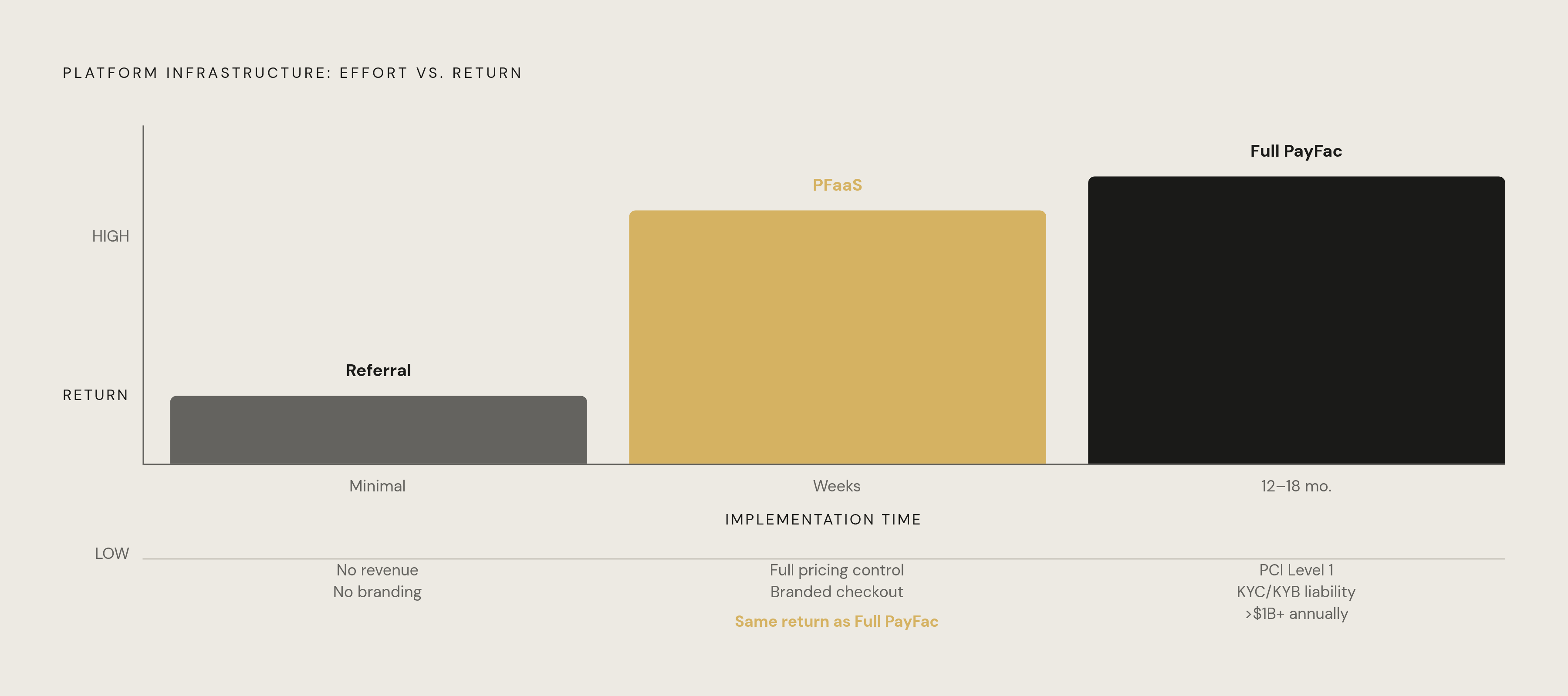
Three distinct paths exist here, and picking the wrong one either wastes money or wastes time. The first is the referral or integrated partnership: the platform sends merchants to a processor and collects a thin referral fee, while the processor keeps the margin and the relationship. It's the lowest-effort option and, unsurprisingly, the lowest-return one.
The second is PayFac-as-a-Service, usually shortened to PFaaS. Here the platform integrates through an API and gets full payment facilitation capability without having to register as a PayFac itself. The provider handles the sponsor bank relationships, the regulatory compliance, and the underwriting, while the platform keeps control over merchant pricing, the onboarding experience, and the merchant relationship itself. Launch timelines run in weeks, not the months or years a full registration would take.
Full PayFac registration means the platform owns PCI Level 1 compliance, sponsor bank relationships, KYC/KYB, chargeback liability, and card network reporting; it takes 12 to 18 months and significant capital, and is best suited for platforms processing over $1B+ annually who require hyper-niche payment options not available via standard APIs.
For most vertical SaaS platforms, PFaaS is the practical answer. It delivers the same merchant control and the same revenue economics as full PayFac ownership, minus the registration overhead that would otherwise eat years of runway. Mastercard's own analysis backs this up: PFaaS can shrink time to market from months down to weeks, and cut merchant onboarding time from weeks down to minutes, which matters a great deal for any platform competing on how fast it can get a new merchant live and processing.
There's a rough threshold worth keeping in mind when deciding between the two. Below that line, PFaaS gets a platform the same control at a fraction of the cost and the timeline.
Under PFaaS, the platform still keeps its own brand on the entire merchant experience, still sets its own pricing, still owns the merchant data relationship, and still earns the payment revenue directly, all without ever having to build or maintain the compliance machinery that the provider supplies. Some providers build a path that lets a platform grow from PFaaS into full PayFac ownership later on the same underlying infrastructure, which matters for any platform that expects to eventually cross that volume threshold. As a decision heuristic for the writer to surface, sourced guidance in S1 indicates that full PayFac registration makes sense above approximately £50M in annual processing volume with dedicated technical and compliance resources in place, while below that threshold, PFaaS delivers equivalent control at a fraction of the cost and timeline.
What white-label payments requires: onboarding, compliance, and operations
Choosing a model is one decision. Running it day to day is another, and it comes with real obligations the platform has to own.
Merchant onboarding sits at the top of that list. The platform becomes the face of the whole process, collecting applications, running KYC and KYB checks, verifying identity, even though the provider actually runs the underwriting that produces those results. How well that onboarding flow is built directly affects how many merchants actually make it through to processing their first transaction. A clunky application form loses merchants before they ever get to see the product's real value.
Risk and compliance work in a similarly split fashion. The platform owns the merchant-facing side of the experience, while the provider manages the regulatory backend and underwriting. Chargebacks and disputes get visibility and tooling from the infrastructure layer, but someone still has to build the actual workflow for reaching out to merchants and walking them through resolution, and that falls on the platform. AML and KYC obligations apply across the whole portfolio of sub-merchants a platform onboards, and while a good provider automates most of that, the platform still needs to understand exactly what's covered and what isn't.
Support is another place where the branding cuts both ways. Because merchants see the platform's name on every payment screen, they call the platform when something breaks, not the provider running the infrastructure behind it. That means staffing and tooling decisions the platform has to plan for ahead of launch, not scramble to fix after the first support ticket about a failed settlement comes in.
Reporting and reconciliation round out the list. The platform has to surface transaction data, settlement timing, and fee breakdowns inside its own interface, which means either building that layer on top of the provider's APIs or using whatever pre-built dashboard components the provider offers. The providers that ease this burden the most tend to offer automated merchant onboarding, built-in AML and KYC, API-accessible reporting, white-label dashboard components, and sandbox environments for testing. Platforms that run into trouble after launch are usually the ones that treated support and reconciliation as an afterthought instead of building for them from day one.
Criteria for evaluating white-label payment providers
Choosing a provider comes down to a handful of concrete questions, not a vibe check on the sales deck.
Start with onboarding capability. Does the provider offer hosted forms and API-driven boarding with auto-configuration, or is it still manual paperwork moving through email? Speed from application to live processing is a real competitive edge in how fast the platform itself can bring merchants on board.
Integration architecture matters just as much. The unified version simplifies both the initial build and everything that comes after it in ongoing maintenance.
Brand control deserves a hard look, too. Does the provider's name show up anywhere at all in the merchant or end-user flow? Custom UI components, payment pages, dashboards, and every piece of merchant communication should carry the platform's own branding, not a trace of the provider underneath.
Revenue model transparency is non-negotiable. Is pricing interchange-plus or flat-rate? Can the platform actually set its own merchant pricing, and is it clear exactly what the provider keeps versus what the platform earns on every transaction? Vague answers here are a warning sign, not a detail to sort out later.
Coverage across Pay In, Pay Out, and Pay Ops rounds out the picture. Accepting payments is the baseline expectation at this point, not a differentiator. Whether a provider also supports disbursements, accounts payable, and the operational tooling around risk, billing, and reporting is what determines whether a platform can offer merchants a genuinely complete financial experience, rather than just a checkout box with the platform's logo pasted on top. Integration architecture matters: a single API covering cards, ACH, and in-person (EMV/POS) versus multiple stitched-together systems, with unified infrastructure simplifying both development and ongoing operations.