Webhook Architecture for Real-Time Payment Event Processing
Webhooks, idempotency, and verification together create reliable payment event handling.

Real-time payment event processing requires more than an HTTP endpoint that accepts notifications. It requires an architecture that preserves payment state through duplicate delivery, downtime, malicious requests, and processing failures. Durable ingestion, idempotency, signature verification, retries, and reconciliation work together to make that architecture reliable enough for embedded payments.
Why payment events cannot wait for polling
A failed payout can leave a worker unpaid, while a disputed charge can require a reserve hold or an operational response. A settlement on an instant rail can complete before the platform reflects that money has moved. These are not ordinary application updates because a missed, duplicated, or delayed transition carries financial and legal consequences. The platform’s view of a payment must therefore stay close enough to the provider’s state for the business to decide what to do next.
With polling, those two states can fall out of step even when every request succeeds. At scale, it also generates redundant requests for active transactions that have not changed, consuming infrastructure budget without removing the delay. RTP and FedNow settle around the clock, every day of the year, so a polling interval measured in minutes does not fit a settlement window measured in seconds. Webhooks replace that repeated checking with notification when a transition occurs. The payment flow becomes a POST of a payment object followed by a payment.settled event in seconds.
What a webhook actually does in a payment pipeline
A webhook is an HTTP POST that a payment provider sends to a registered URL when a state transition occurs. The request carries event data, making the platform a passive receiver. The loop starts with an event from the provider, such as payment.succeeded, payout.delayed, or dispute.opened. The endpoint receives the event, validates it, places it on a queue, and acknowledges receipt with a 2xx response. A background worker then processes the event and updates business state.
That push mechanism complements the pull mechanism of a REST API. Gupta’s two-path architecture paper assigns webhooks the primary role in real-time status propagation and direct API calls the fallback role in reconciliation. For a vertical SaaS platform, the events span three operational planes, namely Pay In, Pay Out, and Pay Ops. Pay In covers how payments are accepted, while Pay Out covers how money is disbursed and the status of AP. Pay Ops covers onboarding, risk, and disputes, so state updates need to arrive on time even when no money is moving.
Why a bare HTTP endpoint fails under production payment load
The simplest way to build it puts business logic right inside the HTTP handler. When a payment event arrives, a slow database write or downstream API call can keep the connection open past the provider’s response timeout. The provider marks delivery as failed and sets a time to try again, even though processing may already have changed business state. Without deduplication, the retried payment.succeeded can produce a double credit, a doubled counter, or a duplicate payout. The delivery failure has become a financial correctness failure.
Downtime exposes a different weakness in the same design. If the endpoint remains unavailable until the provider exhausts its retry window, the consumer may have neither the event nor a record of the delivery attempt. Gupta’s production architecture paper describes this failure in enterprise messaging pipelines, where records get stuck in intermediate states and stay there. A managed platform can also reject or drop requests under load when it hits its caps on concurrent requests or its limits on execution time. A deployment that outlasts the retry window can therefore reveal a structural gap that routine testing never exposed. Fixing it requires changing the endpoint’s job.
The Receive → Queue → Respond pattern and why it redefines the endpoint's job
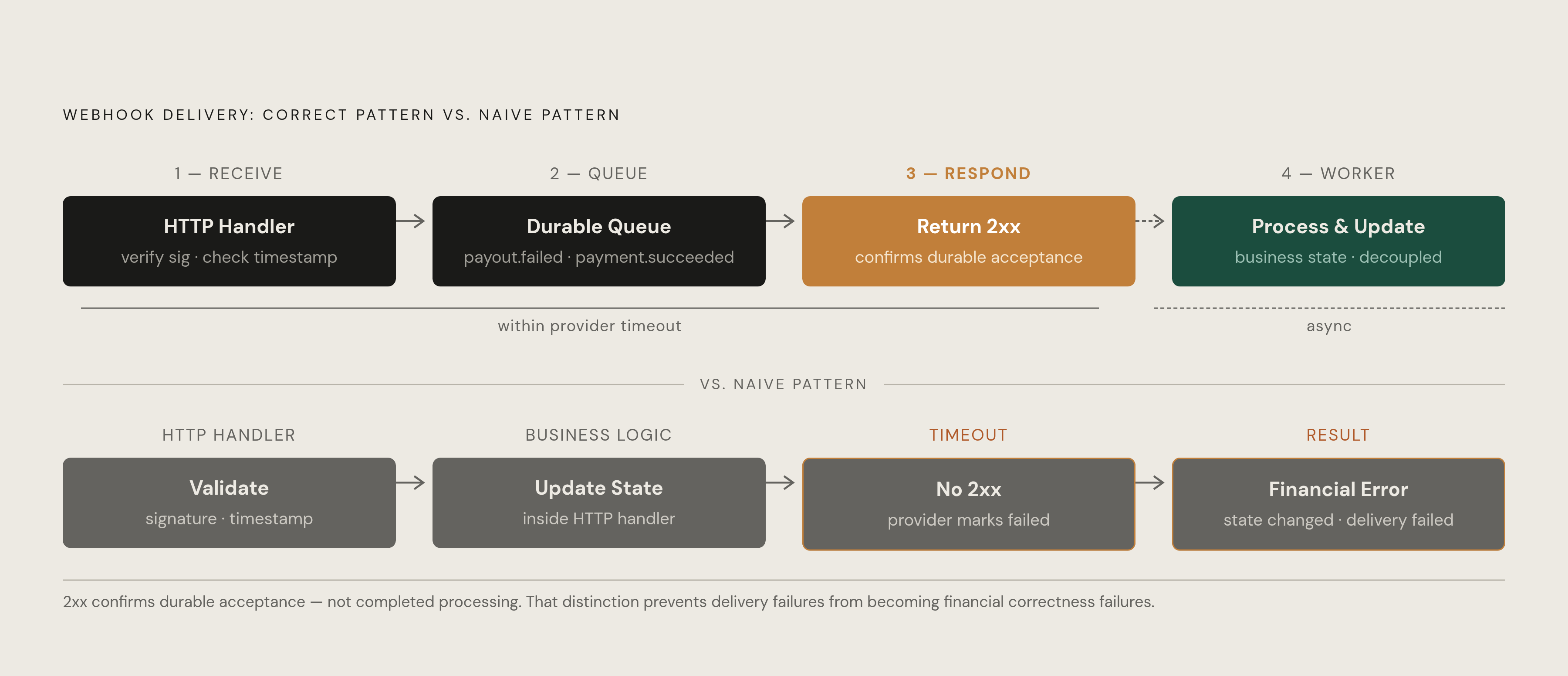
The endpoint should validate the request, enqueue the event durably, and return a 2xx response, in that order and within the provider’s timeout window. Its acknowledgment then means that the event has been accepted for processing, with business operations still to follow. Workers do those operations downstream, so acknowledgment of delivery no longer waits for a slow write to business state. Gupta’s two-path paper uses an internal asynchronous event channel to separate HTTP handling from CRM record processing. The same separation applies to payment events.
Consider a payout.failed event that arrives during a deployment window when ingestion is still available but worker processing has stopped. A durable queue preserves the accepted event until a worker can process it. An in-memory buffer cannot provide that bridge through a process restart or a horizontal scale event that splits context across containers. The queue also absorbs spikes during end-of-month payroll runs or same-day ACH cutoffs, allowing worker processing to proceed separately from incoming traffic. When a change to business state must also create an event, the transactional outbox pattern saves both in the same database transaction, so the record cannot change without an event record to go with it.
Idempotency as the correctness guarantee for at-least-once delivery
A retried payment.succeeded must not cause a second payout, and a retried dispute.opened must not double a reserve hold. These are the concrete stakes of idempotency. Durable queues and retries make repeated delivery a normal condition. Exactly-once delivery is not achievable at the transport layer over an unreliable network. The practical correctness guarantee is at-least-once delivery combined with consumer-side deduplication on a stable event ID.
If the provider-assigned ID shows that an event has already been processed, the worker acknowledges it and exits without repeating business logic. If it has not, processing records the ID atomically with the state change, using a deduplication table or conditional upsert as appropriate. Gupta’s paper describes an idempotent upsert with a state machine, which also lets webhook and reconciliation paths converge on the same result. Outbound idempotency keys serve the symmetric purpose when the platform initiates payments, preventing a retry after a partially failed POST from becoming a duplicate charge or payout.
Signature verification as the security boundary every payment endpoint needs
Idempotency controls repetition, but it does not establish whether an event is genuine. An unverified endpoint is functionally an unauthenticated write API because anyone who discovers its URL can submit a fabricated payment.succeeded event. HMAC-SHA256 provides the standard verification mechanism. The provider signs the raw request body, often with a timestamp, using a shared secret and sends the signature in a header. The receiver recomputes the signature and compares it before the event enters the queue, where workers will treat it as trusted.
The receiver must use raw bytes rather than re-serialized JSON, since reserialization can invalidate signatures and allow body manipulation to survive normalization. Constant-time comparison closes the timing side channel that ordinary string equality can expose. A signing secret stored per endpoint in a secrets manager avoids the leakage risk of keeping it in an environment variable or source repository. Timestamp-based replay protection addresses a separate threat because an authentic request can still be captured and resent. Gupta’s production architecture paper also requires an account identifier match, authentication token presence, and HMAC signature validation, rejecting failures with a 400 or 403 before processing.
Retry logic and dead-letter queues as the durability layer
An authenticated event can still fail during processing, and idempotency alone cannot bring an unavailable dependency back. Retry logic gives valid events another chance to be processed without a new notification from the provider. Exponential backoff gives the consumer time to recover, while jitter spreads attempts across the recovering fleet. Fixed-interval retries instead risk concentrating load at the moment the consumer is least able to handle it.
When all attempts have failed, the event must go into a dead-letter queue so it is not lost without a trace. The DLQ retains the full attempt history, including timestamps, response codes, and error messages, and must support inspection, triage, and selective replay. A dedicated monitoring job alerts operations teams when events accumulate and helps distinguish a transient spike from systematic failure. Gupta’s paper treats prolonged sync-failure detection as a separate architectural component outside the worker. In Pay Out, an unprocessed payout.failed event can mean an unpaid contractor or vendor, while a neglected dispute event can leave its status stale.
The polling fallback that makes the webhook architecture complete
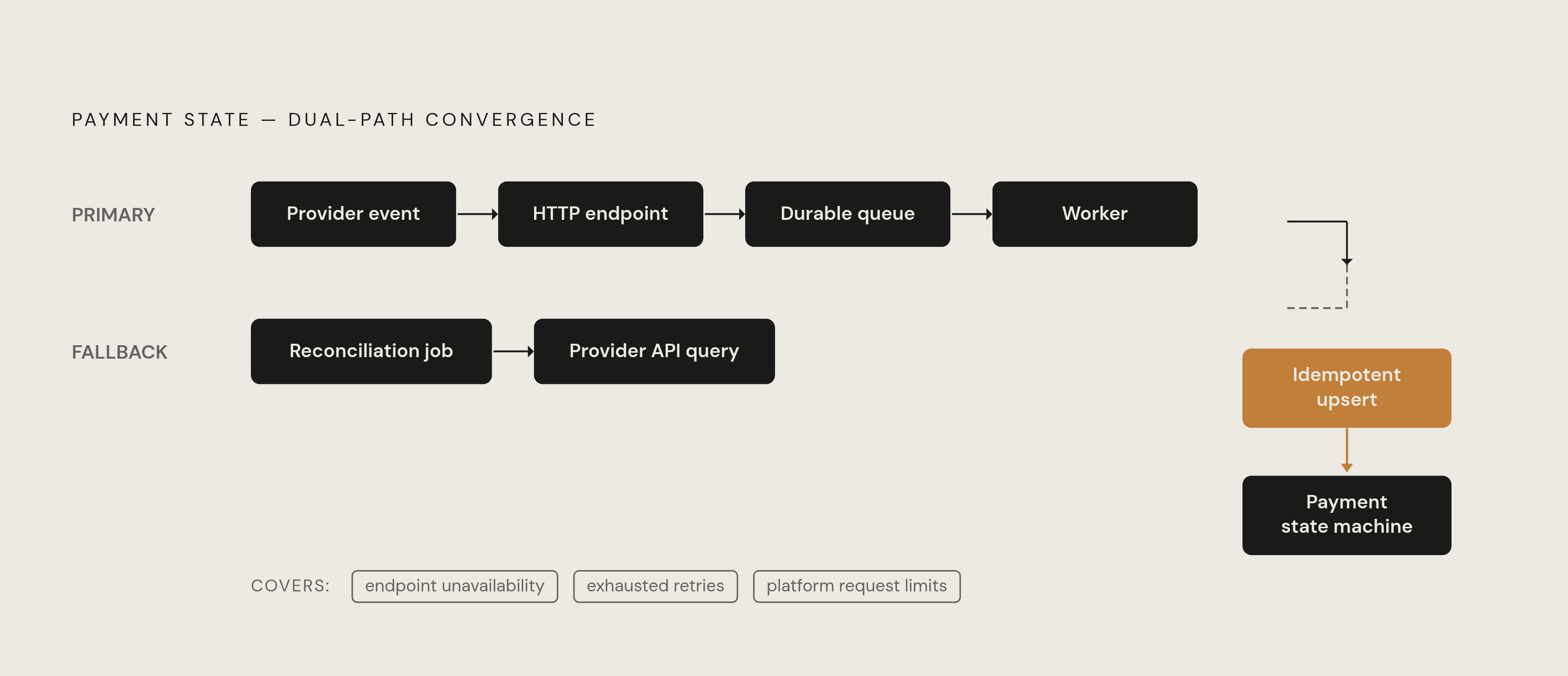
A queue can protect an accepted event, but it cannot preserve a webhook that never reaches the endpoint. That limit is the structural objection to relying on webhooks alone. Gupta’s two-path architecture paper resolves it with a configurable scheduled job that finds records still in transitional status after a configurable interval. The job queries the provider’s status API directly and reconciles the local record. This is a narrowly scoped safety net for failures of the primary path.
Real-time updates still pass through the endpoint, internal event channel, and subscriber on the primary path. The fallback addresses endpoint unavailability, exhausted network retries, and managed-platform request limits when those leave records unresolved. Both paths use an idempotent upsert with a state machine, so they keep the same payment state even when they overlap. A delayed webhook and a reconciliation result can therefore converge on the same correct record. For operations teams, a payment stranded in “sent” is precisely the kind of unresolved state that needs attention before a settlement deadline or dispute window expires.
How instant rails and AI agents raise the cost of architectural gaps
Faster settlement compresses the time available to detect a missing update. When settlement takes two to five days, the longer processing cycle can leave time for reconciliation to recover from a missed webhook. RTP and FedNow settle in seconds with a transaction limit of $10 million, leaving no batch window to absorb the discrepancy. At that speed and scale, settlement is confirmed through a webhook in place of the batch-window model. The fallback must operate on a correspondingly tighter reconciliation interval.
AI-assisted workflows amplify the same gap because payment events become signals that software acts on with less human oversight. If an agent misses a payment.settled event, it may retry a payment and risk a duplicate, or mark a job as incomplete and block downstream work. This does not imply unconstrained autonomous money movement, since authorization remains tightly scoped. The IMF’s 2026 paper on agentic AI payments describes AP2 digitally signed mandates and proof of intent as ways to set limits on what an agent is delegated and authorized to do. Those mandates constrain what an agent may initiate, but they do not replace reliable confirmation of execution. Payment-event architecture therefore helps guarantee that the product works correctly in workflows for agents as well as those for people.
What production-grade looks like across a vertical SaaS payment platform
A production-grade pipeline joins five commitments into one system, namely durable queue-backed ingestion, idempotent processing, HMAC verification with replay protection, exponential-backoff retries with a queryable DLQ, and scheduled reconciliation. The system must cover Pay In events such as payment.succeeded, payment.failed, dispute.opened, and chargeback.initiated. Pay Out requires payout.completed, payout.failed, and payout.delayed, while Pay Ops requires merchant.approved, merchant.suspended, risk.flagged, and tax_form.ready.
The platform’s monetization model determines which of those events become operationally critical. Compared with revenue-share, buy-rate/interchange-plus economics expand the operational scope associated with owning merchant pricing, making dispute, chargeback, and payout-failure events essential controls. A missed or duplicated event can degrade an embedded payment workflow as directly as a UI bug. Treating the pipeline as a core product investment is what makes reliable embedded financial services credible and supports a payments business.