1099 and Tax Reporting Obligations for Platforms Making Disbursements
Platforms must track role, threshold and payee location to file correct 1099s and withhold taxes.
Platforms making disbursements face layered tax reporting obligations under the 2026 rules. The governing rule depends on the platform’s role, the payment route, the payout type and the payee’s location. Compliance therefore starts with classifying the money flow and carries through onboarding, withholding, ledger management and filing.
The three roles that determine which 1099 obligation applies
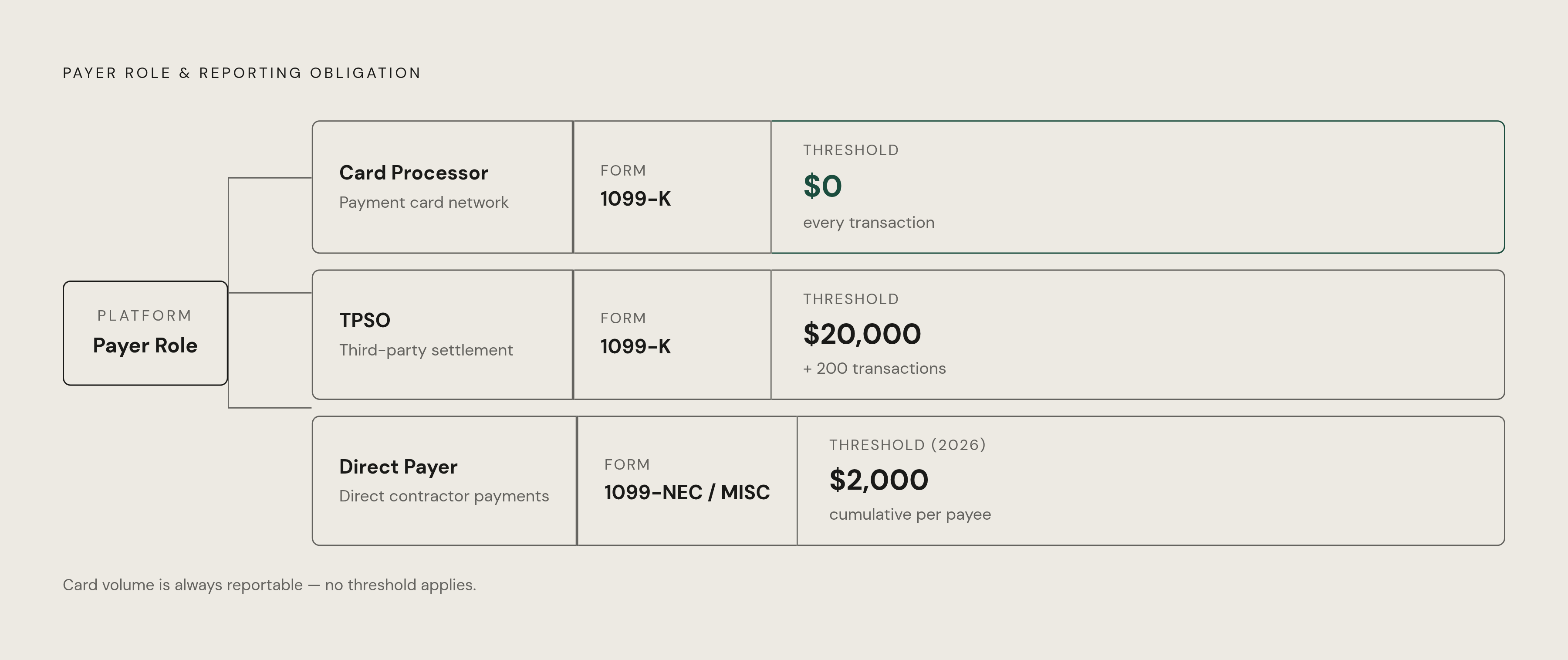
The practical question for a platform builder is which rule applies to its disbursements. A platform can act as a payment card processor, third-party settlement organization (TPSO) or direct payer. Each role depends on how the payments flow, regardless of the platform’s general business category. A single embedded payments platform can occupy all three roles in the same tax year.
Payment card processors, including platforms that use a PayFac or PayFac-as-a-Service structure, report every dollar they process by card on Form 1099-K. TPSOs must file that form when gross goods-and-services payments exceed $20,000 and the transaction count exceeds 200 in the calendar year. Both conditions must be met. Direct payers use Form 1099-NEC or 1099-MISC when applicable cumulative payments to one payee reach $2,000 in 2026. Card settlements, marketplace payouts and direct contractor disbursements therefore need separate reporting logic even when they originate within one product.
What the One Big Beautiful Bill Act settled — and what it left open
The One Big Beautiful Bill Act, signed July 4, 2025, permanently restored the TPSO standard and raised the 1099-NEC and 1099-MISC threshold to $2,000 for 2026 payments. That ended the federal phase-in of the $600 TPSO threshold introduced by the 2021 American Rescue Plan Act. The IRS had delayed implementation for 2022 and 2023 before setting transitional thresholds of $5,000 for 2024 and $2,500 for 2025. The restoration applies retroactively to 2022, but platforms that filed under transitional thresholds do not need to amend or withdraw those returns.
The settlement is narrower than a general relaxation of tax reporting. It did not change the zero-dollar threshold for card processors, and other forms, including 1099-INT, 1099-DIV, 1099-B and 1099-S, retain separate thresholds. The $2,000 threshold will also receive annual inflation adjustments starting in 2027, so accounts payable systems cannot treat it as a permanent constant. More importantly, reporting thresholds govern the payer’s filing duty, while the recipient’s income tax obligation applies independently. State requirements and backup withholding carryover rules add further obligations outside that federal threshold decision.
Why the per-platform threshold rule creates hidden aggregate exposure for payees
The TPSO threshold is measured per platform. A merchant paid less than the threshold by each of three platforms could get no 1099-K and still owe income tax on the income from all three. The absence of a form does not establish that the income is exempt. Although the platform has no legal duty to cover that tax exposure, its support team may still get disputes, questions from audits and requests to correct forms that are not wrong.
A second distinction complicates the recipient’s interpretation of any form that does arrive. Box 1a reports gross transactions before the fees, refunds, chargebacks or returns used to determine taxable net income. Explaining that distinction proactively reduces support friction without taking responsibility for the merchant’s tax return. Within the platform, card and TPSO-style payments to the same payee require transaction-type tagging at the ledger level before year-end classification. Even that separation is incomplete without the geographic layer, because a payee below the federal TPSO threshold may still trigger state reporting.
State-level thresholds that override the federal floor for certain payees
Several states require reporting below the federal TPSO threshold. Massachusetts has a $600 threshold with no transaction minimum, while Virginia also has a $600 threshold. New Jersey sets a $1,000 threshold with no transaction minimum. These differences make payee location part of the filing decision.
A national platform cannot apply one federal setting to its entire payout book. The OBBBA does not automatically change state rules, and state conformity is not guaranteed when federal law changes. Platforms must verify current obligations for every state where they operate or have payees, directly with the state or through their compliance infrastructure. This is a continuing maintenance requirement because state thresholds can change independently of federal action.
How backup withholding and the new carryover rule create an operations trigger at zero dollars
Backup withholding creates a payment-cycle obligation outside ordinary reporting thresholds. The 24% withholding requirement applies from the first dollar paid to a payee without a valid TIN. The $2,000 threshold for 1099-NEC reporting does not postpone that requirement. A small payment can therefore require withholding even when the expected annual total would not require the usual information return.
The Federal Register published final regulations on August 10, 2026 that add a carryover rule for third-party network transactions. If one or more settlement payments to a participating payee were reportable in the preceding calendar year, the following year’s threshold protection does not apply. For a payee without a valid TIN, withholding then applies from the first dollar of subsequent covered payments. This lookback applies only to third-party network settlements.
Gaps in past data can therefore leave both filing work unfinished and tax due on payments being made now. Backup withholding also requires a 1099-K filing on its own, even when payments are below the normal threshold. Platforms must collect W-9s from domestic payees and validate TINs before disbursement begins. Embedded onboarding infrastructure places that work inside Pay Ops, where it can inform the first-payment decision.
Which form applies to which payout type — 1099-K, 1099-NEC, 1099-MISC, and 1042-S
Form selection begins with who pays, how the payment travels, what it pays for and where the recipient is located. For card-processed and qualifying TPSO-routed transactions, the payment settlement entity issues Form 1099-K. That form reports the gross payment volume that falls under the card or network rule. The recipient separately accounts for expenses and returns or allowances when determining taxable income.
For direct nonemployee compensation, the payer uses Form 1099-NEC once cumulative payments to a contractor reach the 2026 threshold. Form 1099-MISC covers applicable miscellaneous payments outside 1099-NEC. These forms report different kinds of payments from 1099-K, so who receives the payment alone cannot determine which form to use.
Form layouts also require attention before filing. The 2026 changes include cash tips in Box 13a and Treasury Tipped Occupation Codes in Box 13b on Form 1099-MISC, together with changes for overtime reporting. The IRS draft 2026 Form 1099-NEC carries a December 2026 revision, but the final version was pending publication in the supplied material. Platforms using templates or pre-printed forms must verify the finalized 2026 layouts before replacing 2025 versions.
Form 1042-S applies to non-U.S. persons who receive domestically sourced income that is subject to withholding. Since January 2026, IRIS has accepted that form with the 1099 series. A unified filing system does not remove the need to identify foreign payees and determine the correct form before payments begin.
The FIRE-to-IRIS transition and what it means for platforms filing at volume
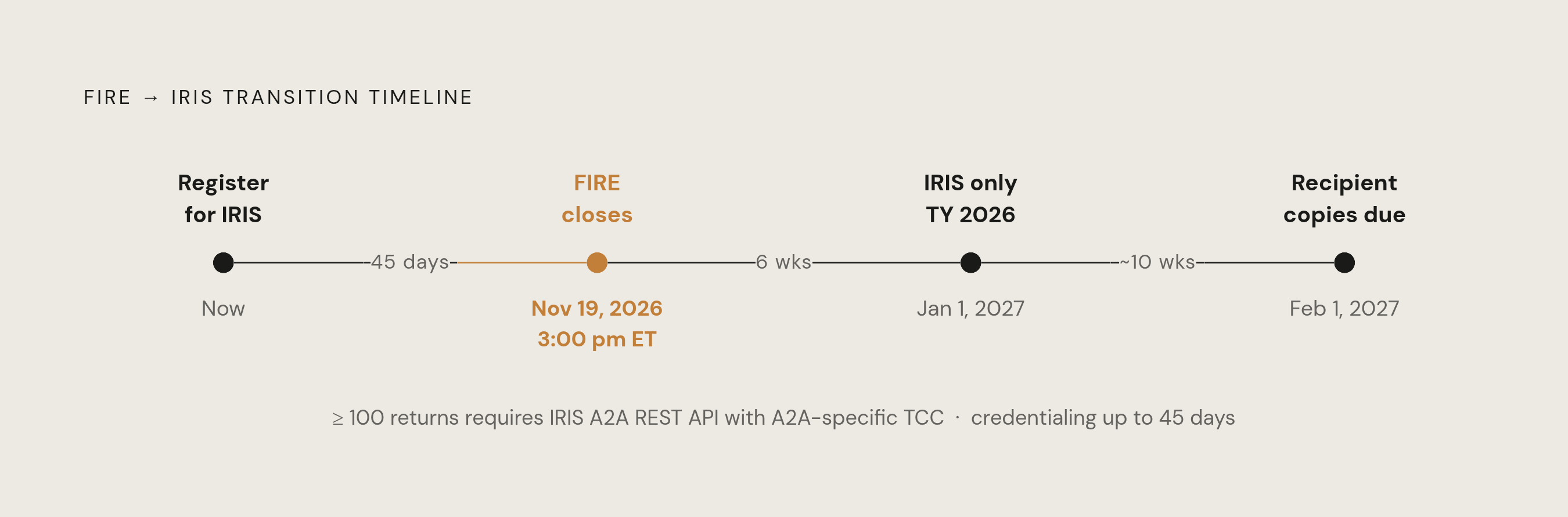
November 19, 2026, at 3:00 p.m. ET is the deadline for submissions through FIRE. All Tax Year 2026 information returns must be filed through IRIS, making the transition an immediate operational task ahead of early 2027. Separate credentialing can take up to 45 days. Platforms that have not begun registration should start immediately.
IRIS provides a Taxpayer Portal for web entry and CSV uploads, and an A2A REST-based API accepting submissions in a structured markup format for high-volume filing. Platforms filing 100 or more returns should use the A2A path, which requires an IRIS A2A-specific TCC. Selecting the channel is therefore also a credentialing decision. An existing filing process is not sufficient unless it can submit through the required system.
IRIS validates TIN and name at submission, bringing remediation forward from the later mismatch notices associated with FIRE. That does not eliminate CP2100 notices, because downstream IRS matching can still identify discrepancies after processing. Submission-time validation strengthens the filing gate, but it does not replace clean onboarding data.
How PayFac and PayFac-as-a-Service architectures concentrate the compliance obligation on the platform
A PayFac or PayFac-as-a-Service architecture places the platform between card networks and sub-merchants. As the payment settlement entity, the platform takes on tax identification collection, payment tracking, backup withholding, 1099-K issuance and filing. The reporting duty follows that position in the flow of funds. It is not delayed until a new merchant reaches meaningful card volume.
The broader operating burden includes KYC, AML, transaction monitoring, sanctions screening, dispute handling and FBO account reconciliation. Even where a financial-services sponsor formally owns the program, practical work lands on the platform that controls the merchant relationship and takes a share of the money flow. Onboarding collection, TIN validation and withholding decisions all depend on that relationship. The architecture therefore determines both revenue participation and the scope of compliance work.
Vertical SaaS platforms have more reporting work when they add embedded accounts payable or contractor payouts. Those workflows need their own direct-payer reporting track, separate from the one for sub-merchant card settlement.
The operational checklist for 1099 compliance across a full disbursement cycle
At onboarding, collect a W-9 from every domestic payee before the first disbursement, regardless of expected payment size. Get the right W-8 series form from non-U.S. payees with domestically sourced income and check whether a 1099 or 1042-S applies. Validate TIN and name against IRS records before payments begin. Tag each relationship by card, TPSO-network or direct-payer transaction type.
As payments go out, keep a running total for each payee for the calendar year. Keep card-processed and TPSO-routed volume separate, and apply 24% backup withholding when required without waiting for a reporting threshold. Review prior-year reportability for the third-party network carryover rule. Monitor payee residence for state obligations, including those in Massachusetts, Vermont, Virginia and New Jersey.
To be ready for year-end, reconcile sub-merchant ledgers each month so that some of the work is done before the filing season. Confirm that finalized 2026 Form 1099-NEC and 1099-MISC layouts are in use. Check that tip reporting includes Treasury Tipped Occupation Codes where required. These checks address both the amounts reported and the structure in which they must be submitted.
At filing, furnish recipient copies of Form 1099-K and Form 1099-NEC by February 1, 2027. Submit Tax Year 2026 returns through IRIS. Use the A2A path for 100 or more returns and obtain the required TCC in advance. Use the same system to file Form 1042-S returns for cross-border payees when required.
Why 1099 compliance is inseparable from the embedded payments revenue model
The infrastructure required for tax reporting is also the infrastructure of a defensible payments business. Accurate payee records, classified transactions and reconciled ledgers give the platform control over its payment data. That control supports interchange optimization, pricing decisions and volume-based monetization. Treating reporting as a year-end bolt-on makes the underlying data harder to use strategically.
Operational control also strengthens the merchant relationship. Taking care of tax reporting gives merchants a reason to stay, while meaningful payment attach rates and a clean compliance record help the platform when its value or a deal is discussed in valuation or M&A discussions. Compliant management of recurring, high-margin payments revenue limits its exposure to regulatory risk. Platforms with integrated Pay Ops can absorb the IRIS transition and carryover rule as system updates instead of separate projects that interrupt core product work.